
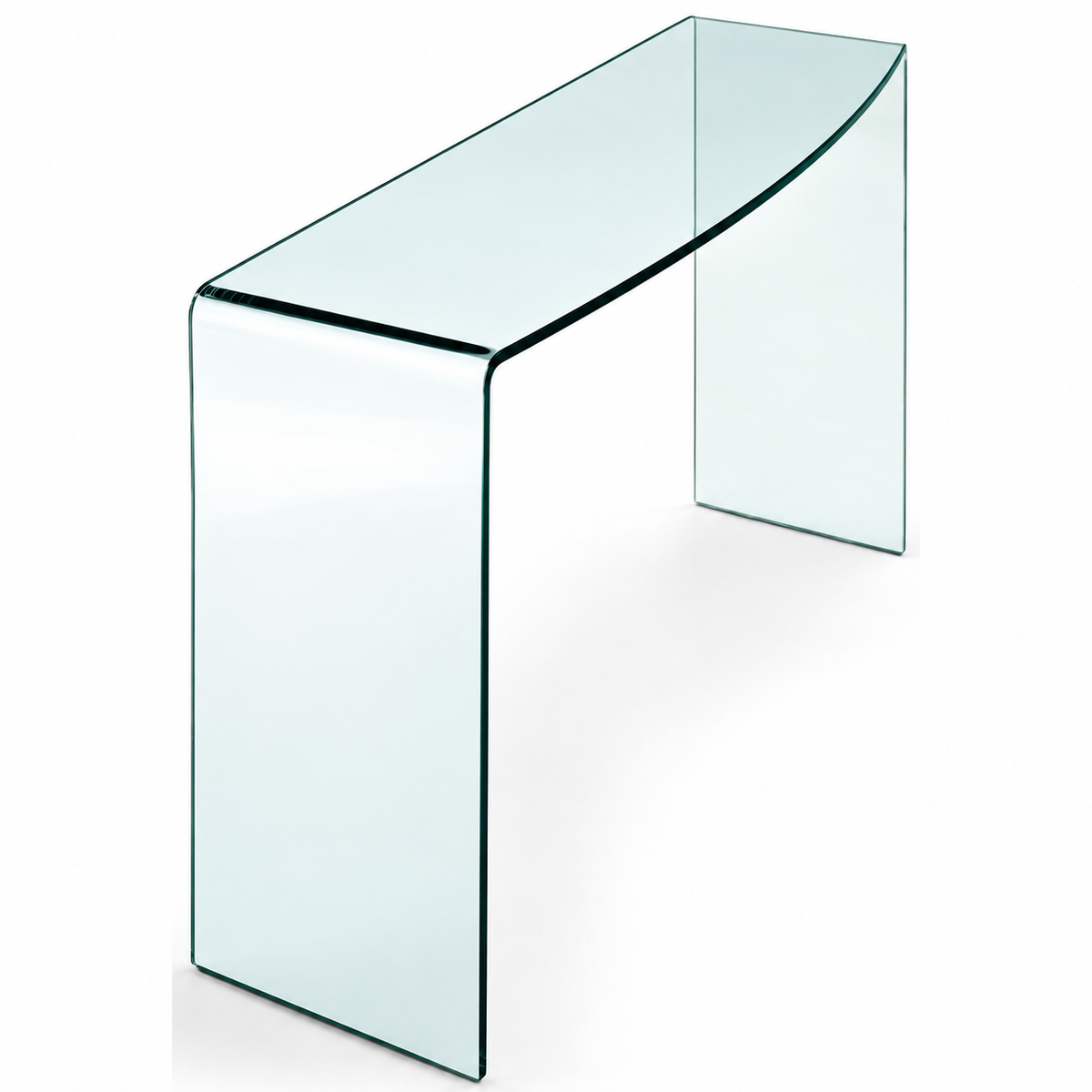
A console table can turn an overlooked hallway, landing or living-room wall into useful space. The challenge is choosing and styling one without narrowing the route or filling the surface with clutter. Clear glass is well suited to this role because it adds function while keeping the wall, flooring and surrounding room visible.
Use this guide to choose the right dimensions, create a balanced display and keep the area practical for everyday life.
Choose the location before the table
Start by deciding what the console needs to do. In an entrance hall it might hold keys, post and a small lamp. In a living room it may provide a place for artwork, a vase or seasonal display. On a landing, it might simply add interest to an otherwise empty wall.
Once the purpose is clear, measure the wall and the walking route in front of it. Record skirting boards, radiators, sockets and door frames. A slim console can work in a narrow area, but only if there is enough unobstructed space for people to pass comfortably.
Get width, depth and height in proportion
The table should feel connected to the wall rather than undersized or squeezed into place. Leave breathing room at both ends unless the design is intentionally fitted to an alcove. Depth is especially important in a hallway: even a few centimetres can affect how freely people move through the space.
Check the height against nearby switches, window sills and any picture or mirror that will hang above it. Mark the full outline with masking tape before buying. This simple step reveals whether the piece looks balanced at eye level and whether its depth intrudes into the route.
Build a balanced display
A successful console arrangement usually combines height, shape and some empty space. Start with one main feature, such as a mirror, framed artwork or lamp. Add one lower object—a bowl, book or small sculpture—and resist the urge to fill every remaining centimetre.
For an asymmetrical display, place a taller object at one end and balance it with two lower pieces at the other. For a more formal look, centre a mirror and use similar lamps or objects on either side. Clear glass works with both approaches because the surface itself remains visually light.
Make the table useful without creating clutter
- Use a small tray or bowl to contain keys rather than spreading them across the surface.
- Keep frequently used items closest to the door or seat where they are needed.
- Hide charging cables where possible and avoid trailing wires across a walkway.
- Leave part of the surface empty so the arrangement looks intentional.
- Review the display occasionally and remove items that have accumulated without a purpose.
Ideas for different rooms
Hallway
Pair the console with a mirror for a final check before leaving home. Add a compact lamp if there is a nearby socket, plus a restrained container for keys. Choose accessories with enough contrast to remain visible against the transparent surface.
Living room
Use the table behind or beside a sofa, or against a wall that needs a lighter piece of furniture. Artwork, a plant and a few books can create a considered vignette without competing with the main seating area.
Landing
A clear console can add function without making the upper hallway feel closed in. Keep the arrangement simple and make sure the route to stairs and doors remains completely clear.
Featured design: 100cm Curved Glass Console Table
The 100cm Curved Glass Console Table measures 100cm wide × 33cm deep × 75cm high. Its 33cm depth is designed for spaces where a full-depth cabinet could feel intrusive, while the 100cm top provides useful room for a lamp, keys or decorative objects.
The table is formed from 12mm bent glass. A sweeping curved edge softens the profile, while the clear construction maintains sightlines through the room. It is a strong option for contemporary hallways, landings and living areas.
Compare it with other sizes and profiles in the glass console table collection.
Common styling mistakes to avoid
- Choosing accessories before measuring: establish the table’s scale and location first.
- Using too many small objects: several unrelated pieces can quickly look untidy.
- Ignoring the view from the side: hallways are approached from different angles, so check the display from both directions.
- Blocking the route: practical clearance matters more than filling an empty wall.
- Forgetting the transparent surface: consider cables, labels and the underside of accessories because they may remain visible.
Frequently asked questions
What depth is suitable for a hallway console?
It depends on the width and traffic of the hallway. Measure the available route and mark the proposed depth on the floor. A slim 33cm design can work well, but the remaining clearance is the deciding factor.
What should I put above a glass console table?
A mirror or artwork gives the arrangement a clear focal point. Position it in relation to the table, then add only the accessories needed to complete the composition.
How do I stop a console table looking cluttered?
Group everyday items in one tray, vary the height of decorative pieces and deliberately leave empty space. Fewer, larger objects often look calmer than many small ones.
The best console tables are useful without dominating the room. Accurate measuring, a clear purpose and a restrained display will help the piece feel like a natural part of the interior.